Content
The Tern and Plover Conservation Partnership works to protect endangered Interior Least Terns and threatened Piping Plovers in Nebraska. We do this by:
- reducing the likelihood of conflicts developing between people and birds
- increasing the amount of habitat available to nesting birds
Who are we?
The TPCP is housed in the University of Nebraska-Lincoln School of Natural Resources and all TPCP staff are employees of the University of Nebraska-Lincoln. The TPCP is a partnership consisting of the University of Nebraska School of Natural Resources, University of Nebraska Extension, Nebraska Game and Parks Commission, United States Fish and Wildlife Service, Nebraska Environmental Trust and a group of cooperators having an interest in tern and plover conservation in Nebraska.
Where do we work?
We work at sand and gravel mines, lake shore housing developments and dredging operations along the:
- Lower Platte River
- Loup River
- Elkhorn River
We also work on sandbars in these rivers.
Why do we do this?
Our research program studying the relationships between Nebraska's rivers and nesting birds helps us better understand and protect the birds. Our outreach program helps us better protect the birds by educating and involving the public in our efforts.
Cliff Swallows of Nebraska
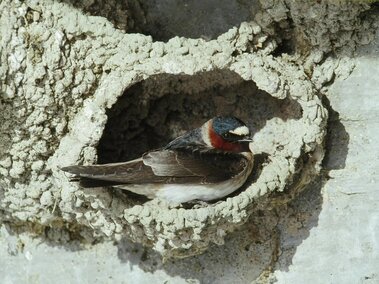
Cliff Swallows (Petrochelidon pyrrhonota) are one of the most social land birds in North America and the most social of all the swallows (Class Aves, Family Hirundinidae). They are social in everything they do, nesting in colonies of 2 to 6000 nests (some pairs will nest solitarily), foraging in groups of hundreds to thousands of birds and spending the winter in large aggregations. And, they are one of the best studied species of bird in the world–they are the focus of a research program based in western Nebraska. The study began in 1982 and was based at the University of Nebraska's Cedar Point Biological Station in Ogallala (Mary Bomberger Brown and Charles R. Brown were the principal investigators).